
Article by Sam Freedman: “LLMs have become so pervasive in our lives that it is easy to forget how new they are. ChatGPT was launched in November 2022, and by May this year 63% of the British population had used it or a competitor. Compare this to take-up of the internet: five years after the public launch of the World Wide Web, just 9% of households had access.
The speed with which LLMs have become familiar and their ability to produce reams of serviceable text has led to rapid, large-scale shifts in behaviour that are overwhelming institutions unable to adapt quickly enough.
Universities are an obvious example: most had shifted to coursework-based examinations just before LLMs made cheating far easier. But the explosion of near-instantaneous text is causing problems everywhere. Employers face a tsunami of AI-generated job applications to be waded through, literary agents are bombarded with AI manuscripts, and complaints departments find themselves overwhelmed.
Government has the biggest problem. Modern administrative states are built around processes that are difficult to use, often deliberately so, which helps ration demand. Regulatory and legal routes are designed on the assumption that only a small number of people who might use them actually will. AI blows this assumption apart. The chart below shows twelve different government services from around the world and the surge in applications/complaints received – the grey line shows when ChatGPT was launched.
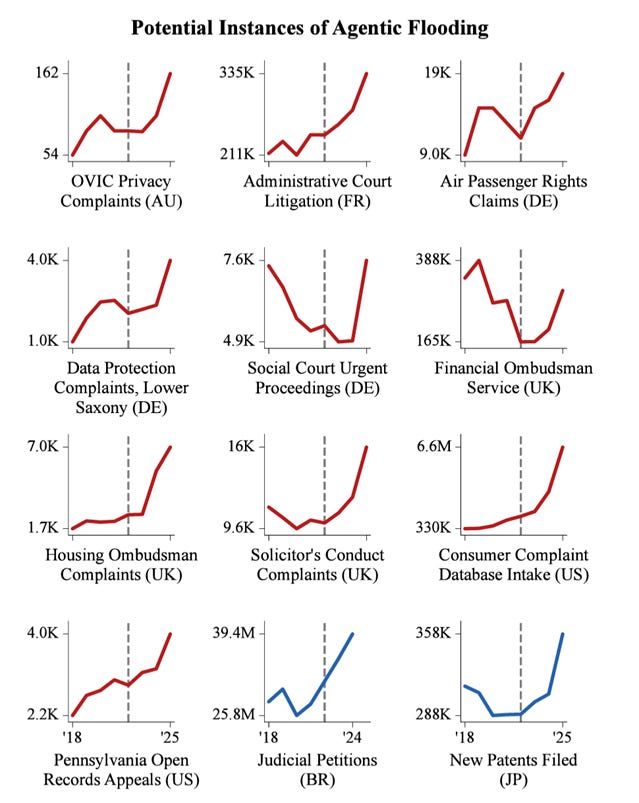
LLMs may not be the only reason for the rises, but are clearly playing an important role. One classification of requests to Google’s Gemini LLM finds that 1% are related to government interactions. That doesn’t sound like much until you realise that is around 2 billion a year for just one LLM. ChatGPT and Claude are more widely used.
The UK is particularly badly set up to deal with this, as we have an extremely centralised administrative state that is heavily dependent on national regulators and tribunals that can be quickly overwhelmed, and what local government we have is seriously under-resourced. In August, The Economist wrote about employment tribunals, which saw a 39% increase in people filing complaints against employers in the year to March. The backlog has shot up and hearings are now being listed to be heard in 2029, harming both unfairly treated employees and businesses. This is being repeated across government agencies…(More)”.
