
Article by Northwestern Innovation Institute: “Federal agencies such as the NIH and the National Science Foundation help determine which scientific ideas receive public support, which researchers are able to pursue ambitious work and which fields gain momentum. Because those decisions shape the future direction of discovery, even subtle shifts in how proposals are written, evaluated and selected can have lasting effects across the research ecosystem.
Yet while large language models such as ChatGPT have rapidly entered classrooms, offices and laboratories, far less attention has been paid to how they may be influencing the grant process itself. Proposal writing is often one of the most time-consuming parts of academic life, and AI tools can reduce that burden by helping draft language, summarize prior work and improve organization.
To examine how those tools may already be affecting funding outcomes, researchers at Northwestern Innovation Institute analyzed confidential proposal submissions from two major U.S. research universities together with the full population of publicly released NIH and NSF awards from 2021 through 2025. The combined dataset —made possible in part through Bridge, a collaborative initiative at the Innovation Institute that integrates research, funding and innovation data across partner institutions — offered a rare window into both funded and unfunded proposals at the earliest stage of the research pipeline.
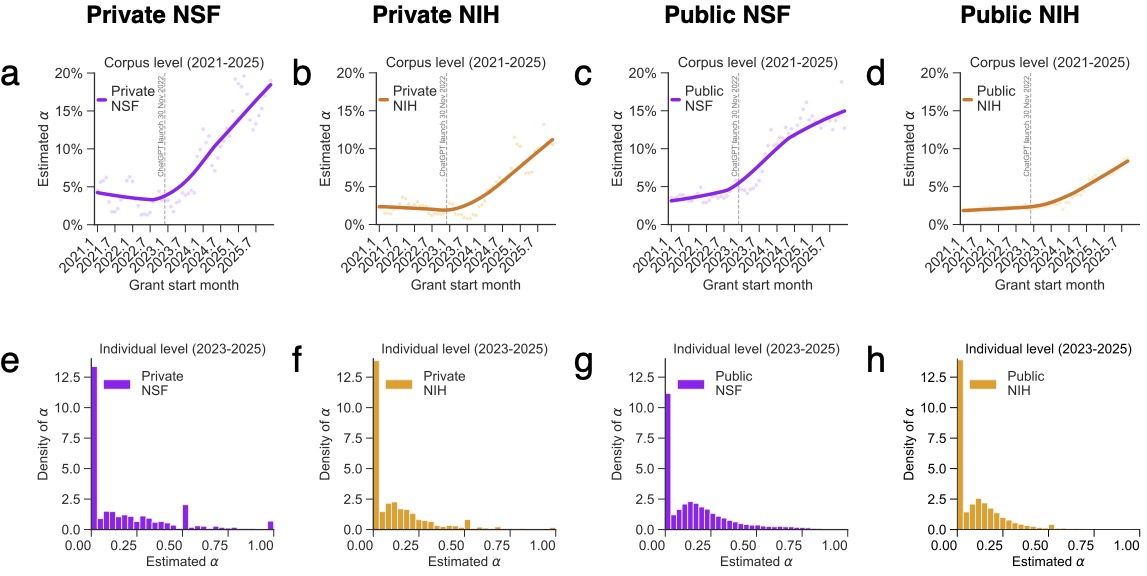
Signs of AI-assisted writing rose sharply beginning in 2023, shortly after generative AI tools became widely available. At NIH, proposals with higher levels of AI involvement were more likely to receive funding and went onto produce more publications. But that productivity gain came with an important qualifier: the additional output was concentrated in ordinary papers rather than the most highly cited work. AI-assisted grants produced more research, but not necessarily more breakthroughs.
Across both agencies, proposals with stronger AI signals also tended to be less distinctive from recently funded work. Crucially, the study found this reflects genuine shifts in what researchers are proposing, not merely how they are writing — when the researchers held scientific content constant and appliedAI rewriting to existing abstracts, the semantic position of those proposals barely changed. The convergence is happening at the level of ideas.
These findings directly address both open questions. The productivity gains — more publications, but not more breakthroughs, and only at NIH, suggest that AI is primarily lowering the cost of communication rather than accelerating scientific execution. And by observing confidential, unfunded proposals alongside funded awards, the study shows that AI’s influence is already operating upstream, reshaping how ideas are articulated and positioned before they ever reach publication…(More)”.
