
Stefaan Verhulst
Book by Anne Beaulieu and Sabina Leonelli: “Data and Society: A Critical Introduction investigates the growing importance of data as a technological, social, economic and scientific resource. It explains how data practices have come to underpin all aspects of human life and explores what this means for those directly involved in handling data. The book
- fosters informed debate over the role of data in contemporary society
- explains the significance of data as evidence beyond the “Big Data” hype
- spans the technical, sociological, philosophical and ethical dimensions of data
- provides guidance on how to use data responsibly
- includes data stories that provide concrete cases and discussion questions.
Grounded in examples spanning genetics, sport and digital innovation, this book fosters insight into the deep interrelations between technical, social and ethical aspects of data work…(More)”.
Article by Kent Walker and Jared Cohen: “Democracies across the world have been through turbulent times in recent years, as polarization and gridlock have posed significant challenges to progress. The initial spread of COVID-19 spurred chaos at the global level, and governments scrambled to respond. With uncertainty and skepticism at an all-time high, few of us would have guessed a year ago that 66 percent of Americans would have received at least one vaccine dose by now. So what made that possible?
It turns out democracies, unlike their geopolitical competitors, have a secret weapon: collective innovation. The concept of collective innovation draws on democratic values of openness and pluralism. Free expression and free association allow for cooperation and scientific inquiry. Freedom to fail leaves room for risk-taking, while institutional checks and balances protect from state overreach.
Vaccine development and distribution offers a powerful case study. Within days of the coronavirus being first sequenced by Chinese researchers, research centers across the world had exchanged viral genome data through international data-sharing initiatives. The Organization for Economic Cooperation and Development found that 75 percent of COVID-19 research published after the outbreak relied on open data. In the United States and Europe, in universities and companies, scientists drew on open information, shared research, and debated alternative approaches to develop powerful vaccines in record-setting time.
Democracies’ self- and co-regulatory frameworks have played a critical role in advancing scientific and technological progress, leading to robust capital markets, talent-attracting immigration policies, world-class research institutions, and dynamic manufacturing sectors. The resulting world-leading productivity underpins democracies’ geopolitical influence….(More)”.
Paper by Joy Hsu, Ramya Ravichandran, Edwin Zhang, and Christine Keung: “There is an increasing need for open data in governments and systems to analyze equity at large scale. Local governments often lack the necessary technical tools to identify and tackle inequities in their communities. Moreover, these tools may not generalize across departments and cities nor be accessible to the public. To this end, we propose a system that facilitates centralized analyses of publicly available government datasets through 1) a US Census-linked API, 2) an equity analysis playbook, and 3) an open data standard to regulate data intake and support equitable policymaking….(More)”.
Kate Kaye at Protocol: “Let the AI auditing vendor brigade begin. A year since it was introduced, New York City Council passed a bill earlier this week requiring companies that sell AI technologies for hiring to obtain audits assessing the potential of those products to discriminate against job candidates. The bill requiring “bias audits” passed with overwhelming support in a 38-4 vote.
The bill is intended to weed out the use of tools that enable already unlawful employment discrimination in New York City. If signed into law, it will require providers of automated employment decision tools to have those systems evaluated each year by an audit service and provide the results to companies using those systems.
AI for recruitment can include software that uses machine learning to sift through resumes and help make hiring decisions, systems that attempt to decipher the sentiments of a job candidate, or even tech involving games to pick up on subtle clues about someone’s hiring worthiness. The NYC bill attempts to encompass the full gamut of AI by covering everything from old-school decision trees to more complex systems operating through neural networks.
The legislation calls on companies using automated decision tools for recruitment not only to tell job candidates when they’re being used, but to tell them what information the technology used to evaluate their suitability for a job.
The bill, however, fails to go into detail on what constitutes a bias audit other than to define one as “an impartial evaluation” that involves testing. And it already has critics who say it was rushed into passage and doesn’t address discrimination related to disability or age…(More)”.
A Preliminary Analysis of Collection Technologies, Data Collection Laws, and Legislative Reform during COVID-19 by Benjamin Ballard, Amanda Cutinha, and Christopher Parsons: “…a preliminary comparative analysis of how different information technologies were mobilized in response to COVID-19 to collect data, the extent to which Canadian health or privacy or emergencies laws impeded the response to COVID-19, and ultimately, the potential consequences of reforming data protection or privacy laws to enable more expansive data collection, use, or disclosure of personal information in future health emergencies. In analyzing how data has been collected in the United States, United Kingdom, and Canada, we found that while many of the data collection methods could be mapped onto a trajectory of past collection practices, the breadth and extent of data collection in tandem with how communications networks were repurposed constituted novel technological responses to a health crisis. Similarly, while the intersection of public and private interests in providing healthcare and government services is not new, the ability for private companies such as Google and Apple to forcefully shape some of the technology-enabled pandemic responses speaks to the significant ability of private companies to guide or direct public health measures that rely on contemporary smartphone technologies. While we found that the uses of technologies were linked to historical efforts to combat the spread of disease, the nature and extent of private surveillance to enable public action was arguably unprecedented….(More)”.
Essay by M. Anthony Mills: “…Yet, the achievement of consensus within science, however rare and special, rarely translates into consensus in social and political contexts. Take nuclear physics, a well-established field of natural science if ever there were one, in which there is a high degree of consensus. But agreement on the physics of nuclear fission is not sufficient for answering such complex social, political, and economic questions as whether nuclear energy is a safe and viable alternative energy source, whether and where to build nuclear power plants, or how to dispose of nuclear waste. Expertise in nuclear physics and literacy in its consensus views is obviously important for answering such questions, but inadequate. That’s because answering them also requires drawing on various other kinds of technical expertise — from statistics to risk assessment to engineering to environmental science — within which there may or may not be disciplinary consensus, not to mention grappling with practical challenges and deep value disagreements and conflicting interests.
It is in these contexts — where multiple kinds of scientific expertise are necessary but not sufficient for solving controversial political problems — that the dependence of non-experts on scientific expertise becomes fraught, as our debates over pandemic policies amply demonstrate. Here scientific experts may disagree about the meaning, implications, or limits of what they know. As a result, their authority to say what they know becomes precarious, and the public may challenge or even reject it. To make matters worse, we usually do not have the luxury of a scientific consensus in such controversial contexts anyway, because political decisions often have to be made long before a scientific consensus can be reached — or because the sciences involved are those in which a consensus is simply not available, and may never be.
To be sure, scientific experts can and do weigh in on controversial political decisions. For instance, scientific institutions, such as the National Academies of Sciences, will sometimes issue “consensus reports” or similar documents on topics of social and political significance, such as risk assessment, climate change, and pandemic policies. These usually draw on existing bodies of knowledge from widely varied disciplines and take considerable time and effort to produce. Such documents can be quite helpful and are frequently used to aid policy and regulatory decision-making, although they are not always available when needed for making a decision.
Yet the kind of consensus expressed in these documents is importantly distinct from the kind we have been discussing so far, even though they are both often labeled as such. The difference is between what philosopher of science Stephen P. Turner calls a “scientific consensus” and a “consensus of scientists.” A scientific consensus, as described earlier, is a relatively stable paradigm that structures and organizes scientific research. By contrast, a consensus of scientists is an organized, professional opinion, created in response to an explicit political or social need, often an official government request…(More)”.
Google blog: “…The U.S. Census is one of the largest data sets journalists can access. It has layers and layers of important data that can help reporters tell detailed stories about their own communities. But the challenge is sorting through that data and visualizing it in a way that helps readers understand trends and the bigger picture.
Today we’re launching a new tool to help reporters dig through all that data to find stories and embed visualizations on their sites. The Census Mapper project is an embeddable map that displays Census data at the national, state and county level, as well as census tracts. It was produced in partnership with Pitch Interactive and Big Local News, as part of the 2020 Census Co-op (supported by the Google News Initiative and in cooperation with the JSK Journalism Fellowships).
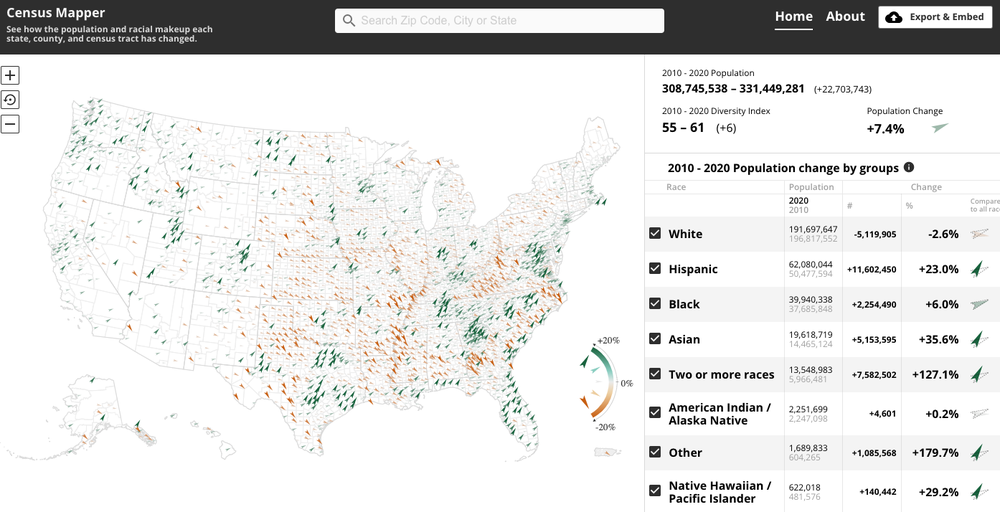
Census Mapper shows where populations have grown over time.
The Census data is pulled from the data collected and processed by The Associated Press, one of the Census Co-op partners. Census Mapper then lets local journalists easily embed maps showing population change at any level, helping them tell powerful stories in a more visual way about their communities.
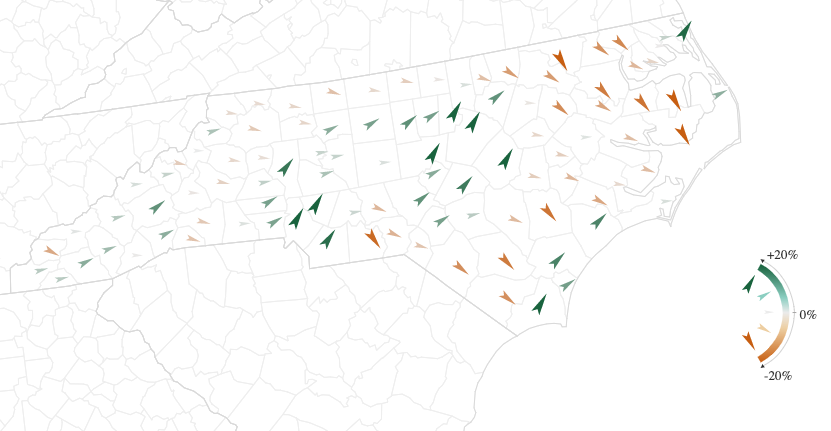
With the tool, you can zoom into states and below, such as North Carolina, shown here.
As part of our investment in data journalism we’re also making improvements to our Common Knowledge Project, a data explorer and visual journalism project to allow US journalists to explore local data. Built with journalists for journalists, the new version of Common Knowledge integrates journalist feedback and new features including geographic comparisons, new charts and visuals…(More)”.
David Bornstein and Tina Rosenberg in the New York Times: “After 11 years and roughly 600 columns, this is our last….
David Bornstein: Tina, in a decade reporting on solutions, what’s the most important thing you learned?
Tina Rosenberg: This is a strange lesson for a column about new ideas and innovation, but I learned that they’re overrated. The world (mostly) doesn’t need new inventions. It needs better distribution of what’s already out there.
Some of my favorite columns were about how to take old ideas or existing products and get them to new people. As one of our columns put it, “Ideas Help No One on a Shelf. Take Them to the World.” There are proven health strategies, for example, that never went anywhere until some folks dusted them off and decided to spread them. It’s not glamorous to copy another idea. But those copycats are making a big difference.
David: I totally agree. The opportunity to learn from other places is hugely undertapped.
I mean, in the United States alone, there are over 3,000 counties. The chance that any one of them is struggling with big problems — mental health, addiction, climate change, diabetes, Covid-19, you name it — is pretty much 100 percent. But the odds that any place is actually using one of the most effective approaches to deal with its problems is quite low.
As you know, I used to be a computer programmer, and I’m still a stats nerd. With so many issues, there are “positive deviants” — say, 2 percent or 3 percent of actors who are getting significantly better results than the norm. Finding those outliers, figuring out what they’re doing that’s different, and sharing the knowledge can really help. I saw this in my reporting on childhood trauma, chronic homelessness and hospital safety, to name a few areas….(More)”
Report by Ciara Staunton et al: “Research, innovation, and progress in the life sciences are increasingly contingent on access to large quantities of data. This is one of the key premises behind the “open science” movement and the global calls for fostering the sharing of personal data, datasets, and research results. This paper reports on the outcomes of discussions by the panel “Open science, data sharing and solidarity: who benefits?” held at the 2021 Biennial conference of the International Society for the History, Philosophy, and Social Studies of Biology (ISHPSSB), and hosted by Cold Spring Harbor Laboratory (CSHL)….(More)”.
Paper by Pranav Gupta and Anita Williams Woolley: “Human society faces increasingly complex problems that require coordinated collective action. Artificial intelligence (AI) holds the potential to bring together the knowledge and associated action needed to find solutions at scale. In order to unleash the potential of human and AI systems, we need to understand the core functions of collective intelligence. To this end, we describe a socio-cognitive architecture that conceptualizes how boundedly rational individuals coordinate their cognitive resources and diverse goals to accomplish joint action. Our transactive systems framework articulates the inter-member processes underlying the emergence of collective memory, attention, and reasoning, which are fundamental to intelligence in any system. Much like the cognitive architectures that have guided the development of artificial intelligence, our transactive systems framework holds the potential to be formalized in computational terms to deepen our understanding of collective intelligence and pinpoint roles that AI can play in enhancing it….(More)”