
Stefaan Verhulst
Article by John B. Morris Jr. and Cameron F. Kerry: “It’s my data.” It’s an idea often expressed about information privacy.
Indeed, in congressional hearings last year, Mark Zuckerberg said multiple times that “people own all of their own content” on Facebook. A survey by Insights Network earlier this year found that 79% of consumers said they want compensation when their data is shared. Musician and tech entrepreneur will.i.am took to the website of The Economist to argue that payment for data is a way to “redress the balance” between individuals and “data monarchs.”
Some policymakers are taking such thinking to heart. Senator John Kennedy (R-LA) introduced a three-page bill, the “Own Your Own Data Act of 2019,” which declares that “each individual owns and has an exclusive property right in the data that individual generates on the internet” and requires that social media companies obtain licenses to use this data. Senators Mark Warner (D-VA) and Josh Hawley (R-MO) are filing legislation to require Facebook, Google, and other large collectors of data to disclose the value of personal data they collect, although the bill would not require payments. In California, Governor Gavin Newsome wants to pursue a “data dividend” designed to “share in the wealth that is created from [people’s] data.”
Treating our data as our property has understandable appeal. It touches what the foundational privacy thinker Alan Westin identified as an essential aspect of privacy, a right “to control, edit, manage, and delete information about [individuals] and decide when, how, and to what extent information is communicated to others.” It expresses the unfairness people feel about an asymmetrical marketplace in which we know little about the data we share but the companies that receive the data can profit by extracting marketable information.
The trouble is, it’s not your data; it’s not their data either. Treating data like it is property fails to recognize either the value that varieties of personal information serve or the abiding interest that individuals have in their personal information even if they choose to “sell” it. Data is not a commodity. It is information. Any system of information rights—whether patents, copyrights, and other intellectual property, or privacy rights—presents some tension with strong interest in the free flow of information that is reflected by the First Amendment. Our personal information is in demand precisely because it has value to others and to society across a myriad of uses.
Treating personal information as property to be licensed or sold may induce people to trade away their privacy rights for very little value while injecting enormous friction into free flow of information. The better way to strengthen privacy is to ensure that individual privacy interests are respected as personal information flows to desirable uses, not to reduce personal data to a commodity….(More)”.
Article by Eyal Weizman: “More than a decade ago, I would have found the idea of a forensic institute to be rather abhorrent. Coming from the field of left activism and critical spatial practice, I felt instinctively oriented against the authority of established truths. Forensics relies on technical expertise in normative and legal frameworks, and smacks full of institutional authority. It is, after all, one of the fundamental arts of the state, the privilege of its agencies: the police, the secret services, or the military. Today, counter-intuitively perhaps, I find myself running Forensic Architecture, a group of architects, filmmakers, coders, and journalists which operates as a forensic agency and makes evidence public in different forums such as the media, courts, truth commissions, and cultural venues.
This reorientation of my thought practice was a response to changes in the texture of our present and to the nature of contemporary conflict. An evolving information and media environment enables authoritarian states to manipulate and distort facts about their crimes, but it also offers new techniques with which civil society groups can invert the forensic gaze and monitor them. This is what we call counter-forensics.
We do not yet have a satisfactory name for the new reactionary forces—a combination of digital racism, ultra-nationalism, self-victimhood, and conspiracism—that have taken hold across the world and become manifest in countries such as Russia, Poland, Hungary, Britain, Italy, Brazil, the US, and Israel, where I most closely experienced them. These forces have made the obscuring, blurring, manipulation, and distortion of facts their trademark. Whatever form of reality-denial “post truth” is, it is not simply about lying. Lying in politics is sometimes necessary. Deception, after all, has always been part of the toolbox of statecraft, and there might not be more of it now than in previous times. The defining characteristics of our era might thus not be an extraordinary dissemination of untruths, but rather, ongoing attacks against the institutional authorities that buttress facts: government experts, universities, science laboratories, mainstream media, and the judiciary.
Because questioning the authority of state institutions is also what counter-forensics is about—we seek to expose police and military cover-ups, government lies, and instances in which the legal system has been aligned against state victims—we must distinguish it from the tactics of those political forces mentioned above.
Dark Epistemology
While “post truth” is a seemingly new phenomenon, for those working to expose state crimes at the frontiers of contemporary conflicts, it has long been the constant condition of our work. As a set of operations, this form of denial compounds the traditional roles of propaganda and censorship. It is propaganda because it is concerned with statements released by states to affect the thoughts and conducts of publics. It is not the traditional form of propaganda though, framed in the context of a confrontation between blocs and ideologies. It does not aim to persuade or tell you anything, nor does it seek to promote the assumed merits of one system over the other—equality vs. freedom or east vs. west—but rather to blur perception so that nobody knows what is real anymore. The aim is that when people no longer know what to think, how to establish facts, or when to trust them, those in power can fill this void by whatever they want to fill it with.
“Post truth” also functions as a new form of censorship because it blocks one’s ability to evaluate and debate facts. In the face of governments’ increasing difficulties in cutting data out of circulation and in suppressing political discourse, it adds rather than subtracts, augmenting the level of noise in a deliberate maneuver to divert attention….(More)”.
Matt Harder at Beyond Voting: “….Below, we’ll explore three websites that allow citizens to communicate better with their governing systems.
Countable.us makes it easier to know what your representatives are voting on, and to tell them how you think they should vote. For each upcoming bill, you can suggest a yea or nay to your representative via email or can even send video messages. Each bill also has a lively debate section so the yeas and nays can share, upvote their opinions and learn from each other. The result is seeing more informed and better arguments in favor of your preferences, and perhaps more importantly, against.
IssueVoter.us is similar to Countable in that you give your opinions to your representatives. But IssueVoter puts a different spin on it by giving you a “scorecard” highlighting how closely your representatives votes align to your preferences. The site is still new, so the functionality is not as great as it could be, but the concept is worth note.
Bang the Table focuses on engagement at a local level. They create civic engagement dashboards for cities that allow residents to stay informed and share opinions about city projects. They offer several levels of engagement, from simply dispensing information for the city to engaging citizens in collective discussions and decision making. Fayetteville, AR used them to make the engagement page Speak Up Fayetteville, which informed citizens about projects such as the Cultural Arts Corridor.
While none of these are driving massive change just yet, it’s easy to imagine how they could be enormously impactful if embraced at scale. First, they will all have to figure out how to design websites which are appealing enough to bring the masses, yet meaningful enough to benefit decision-makers. We’re stuck in the in-between phase where the internet is the most powerful communication medium, but we haven’t learned to utilize it for productive democratic purposes….(More)”.
Anjana Ahuja at the Financial Times: “It should be a moment of cautious optimism: a second promising vaccine has become available to tackle the Ebola outbreak in the Democratic Republic of Congo. Instead, there is uncertainty and angst. Clinicians desperately want to see the new vaccine deployed. But officials in the DRC, unnerved by public reaction to an earlier experimental vaccine, worry that introducing a second one might stoke public suspicions and destabilise containment efforts.
Experts met in the capital Kinshasa last week to work out which way to jump. The dilemma illustrates that human behaviour can be as destructive to global health as any deadly pathogen. Addressing diseases — even the organ-destroying horror that is Ebola — is no longer a matter of merely concocting a vaccine but also persuading people to roll up their sleeves for it. Some academics are even calling for the World Health Organization to establish its own “nudge unit” to apply lessons from behavioural science. While dealing with disease outbreaks “require[s] modifying or working with human behaviour”, they wrote recently in Scientific American, “the global response to these threats lacks a coherent focus on behavioural insights.”…(More)”
Guidance: “The Government Digital Service (GDS) and the Office for Artificial Intelligence (OAI) have published joint guidance on how to build and use artificial intelligence (AI) in the public sector.
This guidance covers how:
- to assess if using AI will help you meet user needs
- the public sector can best use AI
- to implement AI ethically, fairly and safely…(More)”
Paper by Angela G. Winegar and Cass R. Sunstein: “Do consumers value data privacy? How much? In a survey of 2,416 Americans, we find that the median consumer is willing to pay just $5 per month to maintain data privacy (along specified dimensions), but would demand $80 to allow access to personal data. This is a “superendowment effect,” much higher than the 1:2 ratio often found between willingness to pay and willingness to accept. In addition, people demand significantly more money to allow access to personal data when primed that such data includes health-related data than when primed that such data includes demographic data. We analyze reasons for these disparities and offer some notations on their implications for theory and practice.
A general theme is that because of a lack of information and behavioral biases, both willingness to pay and willingness to accept measures are highly unreliable guides to the welfare effects of retaining or giving up data privacy. Gertrude Stein’s comment about Oakland, California may hold for consumer valuations of data privacy: “There is no there there.” For guidance, policymakers should give little or no attention to either of those conventional measures of economic value, at least when steps are not taken to overcome deficits in information and behavioral biases….(More)”.
Bvudzai Magadzire, Melissa West, Emily Lawrence, Julia Guerette & Barbara Jones-Singer at the Stanford Social Innovation Review: ” …At the core of our framework is the idea that solutions must exist within an “enabling context.” The enabling context comprises external conditions such as a country’s level of political stability, government independence, and economic prosperity. Each of these can have a major effect on whether a government entity succeeds in sustaining a solution after an NGO or private-sector partner exits. While these external factors are generally outside most organizations’ control, monitoring them can inform decisions about how to invest time and resources, with the aim of minimizing their negative impacts on a government’s ability to sustain projects.
We are using tools like the PESTLE framework to help identify external factors that could impact the success of programs, as well as reviewing resources from USAID, World Bank, World Health Organization, and other agencies to better understand the political, economic, and social context for transitioning solutions to our government partners. For instance, the government of Malawi has made high-level political commitments to support maternal, adolescent, and child health, but as a low-income country, it has limited funds to spend on health. Thus, reducing costs is critical. VillageReach initially developed a memorandum of understanding (MOU) with the telecommunications provider Airtel—one of two major mobile service providers in Malawi. Since signing the MOU in 2015, Airtel has covered all incoming call and promotional text costs of the hotline, allowing callers to call CCPF for free from any Airtel phone. The government is now managing the MOU with Airtel as part of the transition process.
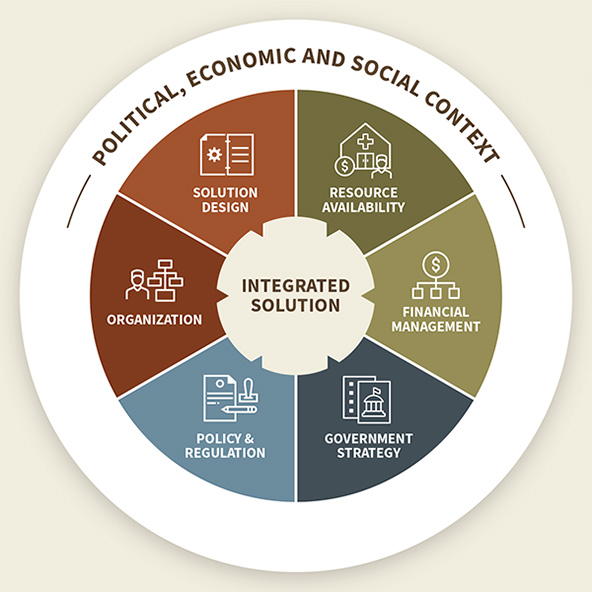
As organizations assess a social solution’s readiness for transition to government, they should consider both the external environment and each of the solution elements. (Illustration by The Medium)
The second tier of our framework combines all the elements integral to a solution’s success that (unlike the enabling context) are within the control of an implementing organization. We call this the “integrated solution,” and it has six elements:
- Solution design: This includes standard operating procedures, guidelines, templates, and job and skill descriptions needed to manage and operate the solution. We are developing a toolkit specifically to support the government in managing CCPF.
- Resource availability: This includes the financial and human resources, as well as infrastructure like buildings and equipment, needed to transition, operate, and maintain the solution. For CCPF, we are supporting the development of a memorandum of understanding between the government and the telecommunications provider Airtel to ensure that the company continues to cover the costs of calls to the hotline.
- Financial management: This covers developing and managing budgets, estimating and managing costs, and disbursing funds in a timely fashion. This process has been important for understanding exactly which budgets need what amount of funds to ensure that operations continue.
- Government strategy: This includes sector (in our case, health-sector) and related government strategies that support the solution’s transition, operation, and maintenance. For CCPF, we needed to ensure that these aligned with Malawi’s broader strategic plan for the health sector.
- Policy and regulatory strategies: These are laws and regulations that affect the solution’s transition, operation, and maintenance. For CCPF, we needed to ensure that the cadre of hotline workers fit into government staffing protocols and that we could legally share certain types of health information with callers.
- Organizational structure: This includes managerial roles and responsibilities, management effectiveness, and governance. CCPF established a steering committee to help maintain alignment and accountability.
Organizations should evaluate and plan for the enabling context and integrated solution concurrently—ideally prior to or early on in the process of developing their solution, and periodically throughout its life….(More)”
Nick Paumgarten at the New Yorker: “…Parcak is a pioneer in the use of remote sensing, via satellite, to find and map potential locations that would otherwise be invisible to us. Variations in the chemical composition of the earth reveal the ghost shadows of ancient walls and citadels, watercourses and planting fields. The nifty kid-friendly name for all this is “archeology from space,” which also happens to be the title of Parcak’s new book. That’s a bit of a misnomer, because, technically, the satellites in question are in the mid-troposphere, and also the archeology still happens on, or under, the ground. In spite of the whiz-bang abracadabra of the multispectral imagery, Parcak is, at heart, a shovel bum…..Another estimate of Parcak’s, based on satellite data: there are roughly fifty million unmapped archeological sites around the world. Many, if not most, will be gone or corrupted by 2040, she says, the threats being not just looting but urban development, illegal construction, and climate change. In 2016, Parcak won the ted Prize, a grant of a million dollars; she used it to launch a project called GlobalXplorer, a crowdsourcing platform, by which citizen Indiana Joneses can scrutinize satellite maps and identify potential new sites, adding these to a database without publicly revealing the coördinates. The idea is to deploy more eyeballs (and, ultimately, more benevolent shovel bums) in the race against carbon and greed….(More)”.
Paper by Timo Minssen, Rajam N. and Marcel Bogers: “Recent EU initiatives and legislations have considerably increased public access to clinical trials data (CTD). These developments are generally much welcomed for the enhancement of science, trust, and open innovation. However, they also raise many questions and concerns, not least at the interface between CTD transparency and other areas of evolving EU law on the protection of trade secrets, intellectual property rights and privacy.
This paper focuses on privacy issues and on the interrelation between developments in transparency and the EU’s new General Data Protection Regulation 2016/679 (GDPR). More specifically, this paper examines: (1) the genesis of EU transparency regulations, including the incidents, developments and policy concerns that have shaped them; (2) the features and implications of the GDPR which are relevant in the context of clinical trials; and (3) the risk for tensions between the GDPR and the policy goals of CTD transparency, including their implications for data sharing and open innovation. Ultimately, we stress that these and other related factors must be carefully considered and addressed to reap the full benefits of CTD transparency….(More)”.
Paper by Bissera Zankova: “The purpose of the study is to analyze the role of social media to boost democratic citizenship and contribute to the creation of smart environment through the perspective of direct democracy in Bulgaria. The issue of “smart cities” will be tackled from a broader media and communication perspective. The term “smart city” does not denote the symbiosis between urban development and new information technologies only but it signifies a new vibrant social ecology rooted in the thorough use of the Internet for wider democratic participation. As a theoretical basis of my survey I shall use Dewey’s model of the inherent bond between communication and enlightened citizenry and Robert Putnam’s theory about the social capital facilitated by social networks generating trust and solidarity among community members. As a case study I shall dwell on local democracy and particularly on two recent referendums in Bulgaria (2017) – in the cities of Tran and Stara Zagora, their basic premises, claims, organization, social media use, outcomes and impact. Though not mandatory for the governing bodies the referendums’ results demonstrated the level of social activity in the country underpinned by networks. Democracy should be understood best through the Abraham Lincoln’s centuries-cherished metaphor as “government of the people, by the people, for the people”. In the current research I build on a previous investigation done in 2013 on civic journalism, blogs and protests in Bulgaria and on my contribution to the book “Smart journalism” (Zankova, Skolkay, Franklin (2016), presenting findings from the New Media Literacy Project 2012 – 2014. This interdisciplinary paper will be useful for both academics and practitioners and specifically for media specialists who will get knowledge about the state of direct democracy in a new democratic country in SEE, new media non/ contribution to this state and what the necessary conditions are to make this democracy really workable at a community level to turn the cities into future-oriented democratic centres….(More)”