
Stefaan Verhulst
Essay by Maurice E. Stucke and Ariel Ezrachi: “All you need to do is say,” a recent article proclaimed, “’I want a beer’ and Alexa will oblige. The future is now.” Advances in technology have seemingly increased our choices and opened markets to competition. As we migrate from brick-and-mortar shops to online commerce, we seemingly are getting more of what we desire at better prices and quality. And yet, behind the competitive façade, a more complex reality exists. We explore in our book “Virtual Competition” several emerging threats, namely algorithmic collusion, behavioural discrimination and abuses by dominant super-platforms. But the harm is not just economic. The potential anticompetitive consequences go beyond our pocketbooks. The toll will likely be on our privacy, well-being and democracy.
To see why, this Essay examines the emerging frontier of digital personal assistants. These helpers are being developed by the leading online platforms: Google Assistant, Apple’s Siri, Facebook’s M, and Amazon’s Alexa-powered Echo. These super-platforms are heavily investing to improve their offerings. For those of us who grew up watching The Jetsons, the prospect of our own personal helper might seem marvelous. And yet, despite their promise, can personalized digital assistants actually reduce our welfare? Might their rise reduce the number of gateways to the digital world, increase the market power of a few firms, and limit competition? And if so, what are the potential social, political, and economic concerns?
Our Essay seeks to address these questions. We show how network effects, big data and big analytics will likely undermine attempts to curtail a digital assistant’s power, and will likely allow it to operate below the regulatory and antitrust radar screens. As a result, rather than advance our overall welfare, these digital assistants – if left to their own devices – can undermine our welfare….(More)”
Springwise: “There are few things more frustrating for cyclists than red lights, especially when riders have built up a good speed only to have to apply the brakes and lose all that momentum. To make things easier Dutch operation Springlab has designed a new system called Flo, which is being tested out in the city of Utrecht and has been set up to work alongside the city’s cycling lanes.
It works by using speed cameras placed 100 metres before each set of traffic lights, and calculates whether or not the cyclist should change speed to hit the green light. It uses animals to inform a cyclist if they should change speed, so a rabbit means speed up, a turtle means slow down, a cow means users are hitting the red light no matter what, and a simple thumbs up indicates the cyclist is doing the right speed.
It’s currently being tested out on Utrecht’s main road Amsterdamsestraatweg and all being well it’s hoped it’ll expand across the rest of the city and hopefully across Holland. Although it’s possible a nation so well known for its love of cycling will embrace such a system, whether or not it’ll go global is another matter. Another recent Dutch-based innovation ByCycling illustrates just how big cycling is in Holland, and in Poland a solar-powered glow in the dark bike lane is a genuinely impressive safety development….(More)”
Book by Catherine Hartung: “This book challenges readers to recognise the conditions that underpin popular approaches to children and young people’s participation, as well as the key processes and institutions that have enabled its rise as a global force of social change in new times. The book draws on the vast international literature, as well as interviews with key practitioners, policy-makers, activists, delegates and academics from Japan, South Africa, Brazil, Nicaragua, Australia, the United Kingdom, Finland, the United States and Italy to examine the emergence of the young citizen as a key global priority in the work of the UN, NGOs, government and academia. In so doing, the book engages contemporary and interdisciplinary debates around citizenship, rights, childhood and youth to examine the complex conditions through which children and young people are governed and invited to govern themselves.
The book argues that much of what is considered ‘children and young people’s participation’ today is part of a wider neoliberal project that emphasises an ideal young citizen who is responsible and rational while simultaneously downplaying the role of systemic inequality and potentially reinforcing rather than overcoming children and young people’s subjugation. Yet the book also moves beyond mere critique and offers suggestive ways to broaden our understanding of children and young people’s participation by drawing on 15 international examples of empirical research from around the world, including the Philippines, Bangladesh, the United Kingdom, North America, Finland, South Africa, Australia and Latin America. These examples provoke practitioners, policy-makers and academics to think differently about children and young people and the possibilities for their participatory citizenship beyond that which serves the political agendas of dominant interest groups…(More)”.
Dhruv Khullar in the New York Times: “…We in the medical community have only recently started to explore how behavioral economics can improve health. As with any hot field, there’s always the possibility of hype. But these insights might be particularly valuable in health care because medical decision-making is permeated with uncertainty, complexity and emotion — all of which make it hard to weigh our options.
A leader of this movement is Dr. Kevin Volpp, a physician at the University of Pennsylvania and founding director of the Center for Health Incentives and Behavioral Economics. He designs randomized trials around some of health care’s most important challenges: nudging doctors to provide evidence-based care; ensuring patients take their medications; and helping consumers choose better health plans.
“There’s starting to be a broad recognition that decision-making environments in health care could better reflect how doctors and patients actually make decisions,” he said.
Dr. Volpp, whose work is used by both the public and private sector, recently collaborated with CVS Caremark to test which financial incentives are most effective for getting employees to quit smoking. Employees were randomly assigned to one of three groups. The first was “usual care,” in which they received educational materials and free smoking cessation aids. The second was a reward program: Employees could receive up to $800 over six months if they quit. The third was a deposit program, in which smokers initially forked over $150 of their money, but if they quit, they got their deposit back along with a $650 bonus.
Compared with the usual care group, employees in both incentive groups were substantially more likely to be smoke-free at six months. But the nature of the incentives mattered. Those offered the reward program were far more likely to accept the challenge than those offered the deposit program. But the deposit program was twice as effective at getting people to quit — and five times as effective as just pamphlets and Nicorette gum.
Parting with your own money is painful. But it is effective.
That’s also a lesson in Volpp-led research on getting people to lose weight and exercise more. One recent study gave incentives to patients by entering them into lotteries or into deposit contracts for meeting weight loss goals. Those in the lottery group were eligible for a daily lottery prize with frequent small payouts and occasional large rewards — but only if they clocked in at or below their weight loss goal. People in the deposit group invested their own money (generally a few dollars a day), which was then matched by researchers. They’d get their money back — and then some — if they met their goal at the end of the month….(More)”
OECD Report: “The Government of Chile has set out a vision to develop a more inclusive society, and sees public sector innovation as a means to achieve it. But in order to achieve these ambitious goals, the Government will need to improve the innovation-related skills and capabilities of the Chilean public service. This report, the first of its kind on an OECD country, assesses the abilities, motivations and opportunities in Chile’s public service for contributing to innovation, and provides recommendations on how to further develop them….(More)”
Jacob Poushter at Pew: “Despite the seeming ubiquity of social media platforms like Facebook and Twitter, many in Europe, the U.S., Canada, Australia and Japan do not report regularly visiting social media sites. But majorities in all of the 14 countries surveyed say they at least use the internet.
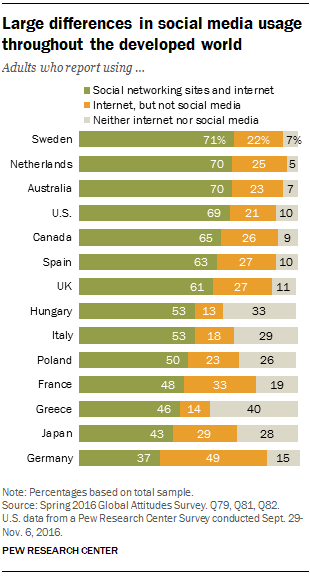 Social media use is relatively common among people in Sweden, the Netherlands, Australia and the U.S. Around seven-in-ten report using social networking sites like Facebook and Twitter, but that still leaves a significant minority of the population in those countries (around 30%) who are non-users.
At the other end of the spectrum, in France, only 48% say they use social networking sites. That figure is even lower in Greece (46%), Japan (43%) and Germany (37%). In Germany, this means that more than half of internet users say they do not use social media.
The differences in reported social media use across the 14 countries are due in part to whether people use the internet, since low rates of internet access limit the potential social media audience. While fewer than one-in-ten Dutch (5%), Swedes (7%) and Australians (7%) don’t access the internet or own a smartphone, that figure is 40% in Greece, 33% in Hungary and 29% in Italy.
However, internet access doesn’t guarantee social media use. In Germany, for example, 85% of adults are online, but less than half of this group report using Facebook, Twitter or Xing. A similar pattern is seen in some of the other developed economies polled, including Japan and France, where social media use is low relative to overall internet penetration….(More)
Priyanka Dutt at BBC Media Action: “Anyone working in international development will attest that human-centred design (HCD) has been a ‘trending topic’ in recent years. Design thinking has been applied to a range of challenges, from supporting democratic transition in Libya to building an all-terrain wheelchair for under $200. Melinda Gates even hailed HCD as the innovation changing the most lives in the developing world.
But what exactly is design thinking? It involves bringing together multi-disciplinary teams – think creative writers working alongside ICT specialists – to address challenges through rapid prototyping and repeated testing. At the core of HCD is building empathy with the people you’re designing for with the overarching aim of producing something genuinely valuable to them.
Marrying these principles with our own core value of putting audiences at the heart of everything we do, we decided to set up a ‘laboratory’ in Bihar, in northern India, which aimed to improve child and maternal health through communication. We saw Bihar as a great site for HCD-style innovation because it offered us the scope to test and fine tune new ways of using communication to promote healthy behaviours for women and children alike.
Bihar is home to 29 million women of reproductive age, who give birth 3 million times every year. And although Bihar’s maternal mortality rate has declined in recent years to 93 per 100,000 live births, it is still well above the Sustainable Development Goals target of 70. As for the communication challenges, less than a fifth of these women watch TV and only 12% listen to the radio.
Yet the lab’s early creations achieved a great deal. Over 50,000 people have graduated from our Mobile Academy training course, which is delivered through mobile phone audio messages. The course teaches health workers how to communicate more effectively to persuade families to lead healthier lives.
We also produced a set of cards and audio messages delivered via mobile phone – called Mobile Kunji – for health workers to use during their visits with families. The evidence shows that families subsequently asked health workers more questions and were more likely to follow advice on preparing for birth, family planning and how to feed babies.
Rethinking strategy: learning from failure
High on our early successes, we set about developing Kilkari (a baby’s gurgle in Hindi). This programme sends weekly audio messages about pregnancy, child birth, and child care, directly to families’ mobile phones, from the second trimester of pregnancy until the child is one year old. The aim was that Kilkari would be listened to across Bihar, by the most vulnerable families, with the greatest need and least access to information and services.
Drawing on lessons from two similar services from around the world, Mobile Midwife and BabyCenter, in addition to our own prior experience in Bihar, we were confident Kilkari would be a success. Just to be certain, we ran some tests before rollout and found that we had failed in our vision – and spectacularly so. We weren’t getting through to our main audience, women, as we weren’t using the right channels and language.
In the end, we went back to the drawing board on Kilkari four times, simplifying and stripping down the content time and again, until we got it right. Through repeated prototype-test-redesign cycles, we made the vitally important discovery that our basic assumptions about our audiences were wrong. So we went back to basics and asked ourselves the following questions to push us to rethink our strategy:
1. Is the content relevant and easy to understand?…
2. Are we getting through to our target audience?…
3. Can we do more to keep our target audience engaged?…(More)”
/AI-Assistant-Pilot: “Welcome to GSA’s Emerging Citizen Technology program’s pilot for the effective, efficient and accountable introduction and benchmark of public service information integration into consumer-available AI Personal Assistants (IPAs) including Amazon Alexa, Google Assistant, Microsoft Cortana, and Facebook Messenger’s chatbot service — and in the process lay a strong foundation for opening our programs to self-service programs in the home, mobile devices, automobiles and further.
This pilot will require rapid development and will result in public service concepts reviewed by the platforms of your choosing, as well as the creation of a new field of shared resources and recommendations that any organization can use to deliver our program data into these emerging services.
Principles
The demand for more automated, self-service access to United States public services, when and where citizens need them, grows each day—and so do advances in the consumer technologies like Intelligent Personal Assistants designed to meet those challenges.
The U.S. General Services Administration’s (GSA) Emerging Citizen Technology program, part of the Technology Transformation Service’s Innovation Portfolio, launched an open-sourced pilot to guide dozens of federal programs make public service information available to consumer Intelligent Personal Assistants (IPAs) for the home and office, such as Amazon Alexa, Microsoft Cortana, Google Assistant, and Facebook Messenger.
These same services that help power our homes today will empower the self-driving cars of tomorrow, fuel the Internet of Things, and more. As such, the Emerging Citizen Technology program is working with federal agencies to prepare a solid understanding of the business cases and impact of these advances.
From privacy, security, accessibility, and performance to how citizens can benefit from more efficient and open access to federal services, the program is working with federal agencies to consider all aspects of its implementation. Additionally, by sharing openly with private-sector innovators, small businesses, and new entries into the field, the tech industry will gain increased transparency into working with the federal government….(More)”.
Nathaniel Persily in the Journal of Democracy: “…The actual story of the 2016 digital campaign is, of course, quite different, and we are only beginning to come to grips with what it might mean for campaigns going forward. Whereas the stories of the last two campaigns focused on the use of new tools, most of the 2016 story revolves around the online explosion of campaign-relevant communication from all corners of cyberspace. Fake news, social-media bots (automated accounts that can exist on all types of platforms), and propaganda from inside and outside the United States—alongside revolutionary uses of new media by the winning campaign—combined to upset established paradigms of how to run for president.
Indeed, the 2016 campaign broke down all the established distinctions that observers had used to describe campaigns: between insiders and outsiders, earned media and advertising, media and nonmedia, legacy media and new media, news and entertainment, and even foreign and domestic sources of campaign communication. How does one characterize a campaign, for example, in which the chief strategist is also the chairman of a media website (Breitbart) that is the campaign’s chief promoter and whose articles the candidate retweets to tens of millions of his followers, with those tweets then picked up and rebroadcast on cable-television news channels, including one (RT, formerly known as Russia Today) that is funded by a foreign government?
The 2016 election represents the latest chapter in the disintegration of the legacy institutions that had set bounds for U.S. politics in the postwar era. It is tempting (and in many ways correct) to view the Donald Trump campaign as unprecedented in its breaking of established norms of politics. Yet this type of campaign could only be successful because established institutions—especially the mainstream media and politicalparty organizations—had already lost most of their power, both in the United States and around the world….(More)”
Ladislav Kristoufek, Helen Susannah Moat and Tobias Preis in EPJ Data Science: “Data on the number of people who have committed suicide tends to be reported with a substantial time lag of around two years. We examine whether online activity measured by Google searches can help us improve estimates of the number of suicide occurrences in England before official figures are released. Specifically, we analyse how data on the number of Google searches for the terms ‘depression’ and ‘suicide’ relate to the number of suicides between 2004 and 2013. We find that estimates drawing on Google data are significantly better than estimates using previous suicide data alone. We show that a greater number of searches for the term ‘depression’ is related to fewer suicides, whereas a greater number of searches for the term ‘suicide’ is related to more suicides. Data on suicide related search behaviour can be used to improve current estimates of the number of suicide occurrences….(More)”