
Article by Stefaan Verhulst and Begoña G. Otero: “The European Commission’s Technological Sovereignty Package (IP/26/1187) marks an important moment in the global political economy of the digital age. Presented by Commission President Ursula von der Leyen as an existential imperative for protecting critical infrastructure, the initiative signals an increasingly assertive European response to a rapidly changing geopolitical landscape. Through proposed initiatives such as the Chips Act 2.0, the Cloud and AI Development Act, the Open Source Strategy, and the Strategic Roadmap for Digitalisation and AI in Energy, Brussels has made clear that digital infrastructure is no longer viewed merely as an engine of economic growth but as a strategic asset central to security, competitiveness, and geopolitical influence.
Together, these measures seek to strengthen Europe’s position across the full digital value chain: expanding domestic semiconductor production and advanced chip design capabilities; tripling Europe’s data center capacity over the coming five to seven years; accelerating the deployment of cloud and AI infrastructure; scaling the adoption of artificial intelligence through a network of Experience and Acceleration Centres (AI Factories); promoting open-source alternatives in cloud, AI, cybersecurity, internet technologies, and semiconductors; and integrating digital infrastructure more directly into Europe’s energy system.
Yet technological sovereignty should not be understood as an end in itself. The ultimate objective cannot simply be to manufacture more chips, build more data centers, or host more AI models within European borders. Rather, it should be to ensure that individuals, communities, businesses, and public institutions have meaningful agency over the digital systems that increasingly shape economic opportunity, democratic participation, cultural expression, and public life. Viewed through this lens, the debate around technological sovereignty is fundamentally a debate about digital self-determination: who has the ability to shape the digital systems upon which society depends, under what conditions, and for whose benefit. What follows, then, is that tackling asymmetry by creating new asymmetries is not a desirable outcome. A sovereignty that simply transfers concentrated power from foreign to domestic hands, or that substitutes one set of gatekeepers for another, would resolve the geopolitical problem while reproducing the democratic one. How an infrastructure distributes powers is not fixed by the technology itself but by the institutions and rules built around it: concentration is a choice, not an inevitability. What matters then is not who holds power over digital systems but whether that power is distributed, accountable, and open to challenge.
The Triad of Tech Sovereignty
As the global debate over technological sovereignty intensifies, this quest is increasingly unfolding across three interconnected dimensions (what we call the “Triad of Tech Sovereignty”):
- the weaponization of structural dependency, where reliance on foreign infrastructure becomes vulnerability;
- the weaponization of digital openness, where access and interoperability become mechanisms for extraction; and
- systemic asymmetries of agency, where those most affected by decisions and technical systems often have the least say.
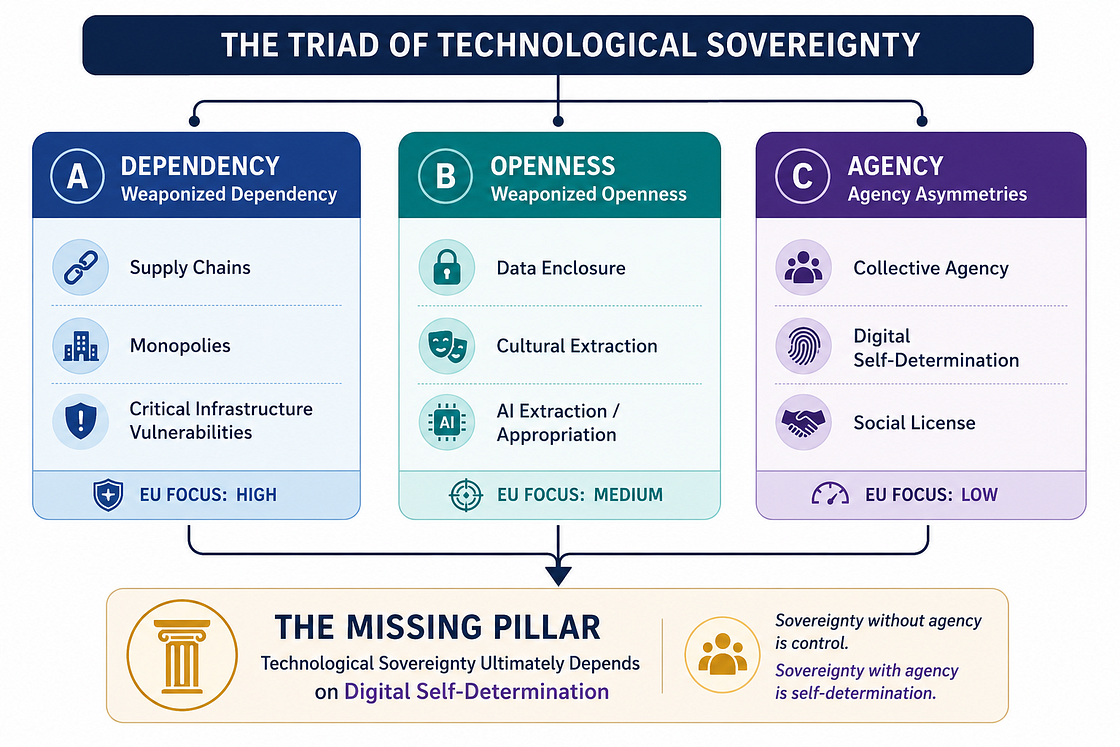
While Europe’s latest initiatives offer substantial responses to the first dimension and growing attention to the second, the third is noticeably misaligned. By prioritizing the hard infrastructure of sovereignty over the democratic imperative of self-determination, Europe risks building an impressive industrial fortress without securing the social foundations required to sustain it…(More)”.
