Report by DemNext: “Democracy is under strain, and one of the most promising responses to that strain is the growing global movement around deliberative assemblies: citizens’ assemblies, citizens’ juries, and related forums that bring randomly selected, broadly representative groups of people together to weigh evidence, listen to one another, and make shared decisions on complex public issues. Over 1,000 such processes have now been run worldwide, and a growing body of evidence suggests they depolarise opinion, generate well-reasoned recommendations, build trust, and reconnect people to political life.
However, these processes are also resource-intensive, slow, and hard to scale, and have thus become a site of intense interest for AI integration. The pitch from many technologists, practitioners, and funders is consistent: AI can make deliberation cheaper, faster, more accessible, and more scalable.
In this paper, we argue that AI, when designed with care, can indeed play a powerful role in strengthening deliberation. But the very efficiencies that make AI attractive also risk undermining what deliberation is for in the first place. Whether AI strengthens or weakens deliberation or strengthens is not predetermined, however; it is a matter of design.
Our starting point is that deliberative assemblies are not decision-making machines whose sole value lies in the recommendation they produce. They are also spaces in which participants exercise and develop the civic capacities that democratic life depends upon. If we automate too much, we may end up with smoother processes that hollow out the productive friction that makes them valuable, while simultaneously reducing people’s ability to participate in democratic life.
These considerations are relevant to all places where deliberation takes place – workplaces, schools and universities, museums, financial institutions, corporations and cooperatives, membership-based associations, and other organisations.
We make three contributions.
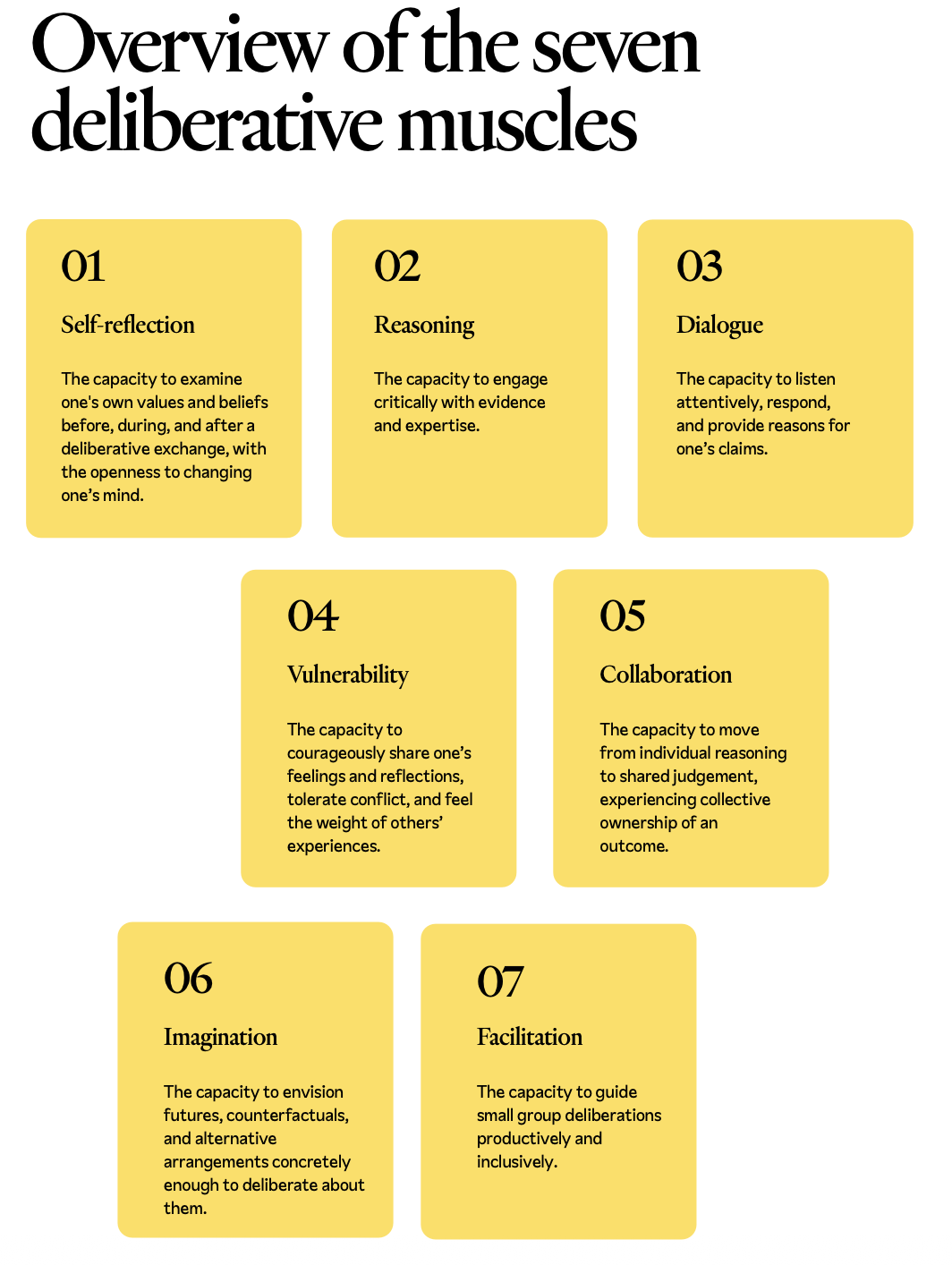
First, we argue that one of the most important and most overlooked virtues of deliberative assemblies is that they build deliberative muscles: the cognitive, dispositional, and relational capacities that citizens need to do the work of democracy together. We use the language of muscle deliberately. A muscle is not an idea one holds; it is a capacity one maintains through practice, weakens when unused, and improves when trained.
Second, we offer a typology of seven deliberative muscles: self-reflection (examining one’s own values and beliefs), reasoning (engaging critically with evidence and expertise), dialogue (listening attentively, responding, and giving reasons), vulnerability (sharing feelings and reflections, tolerating conflict, feeling the weight of others’ experiences), collaboration (moving from individual reasoning to shared judgement), imagination (envisioning futures and alternatives concretely enough to deliberate about them), and facilitation (guiding small-group deliberation productively and inclusively)…(More)”.